Discoveries
Sixteen stories from the official record
16 researched discoveries, each tied to an official National Park Service or Natural History Museum sentence.
Was it a tiger?
Official NPS wording: “Though sometimes called a “saber-toothed tiger”, Smilodon is not directly related to tigers or other pantherine cats.”[source]
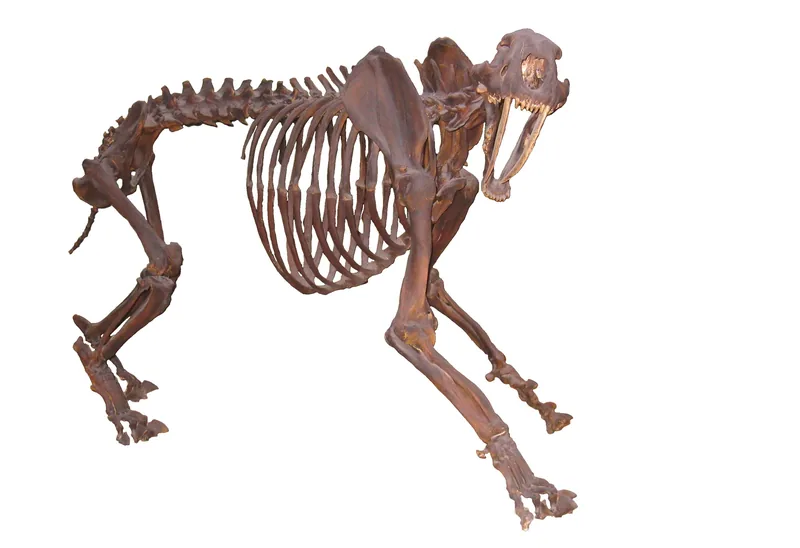
A fossil of Smilodon fatalis in the Utah Museum of Natural History, Salt Lake City (now the Natural History Museum of Utah), photographed by Daderot on 16 November 2009. This is a fossil, not a living animal. Public domain. Photo: Daderot, 16 November 2009 · Public domain · Wikimedia Commons Fate scalpel tooth
Smilodon fatalis, official wording says, means “fate scalpel tooth,” referring to blade-like upper canines that could reach 11 inches.[source]
Eleven inches, and 28 centimetres
The NPS 11-inch figure is for S. fatalis. An NHM page gives canines “as long as 28 centimetres,” without naming a species. Both are kept.[source][source]
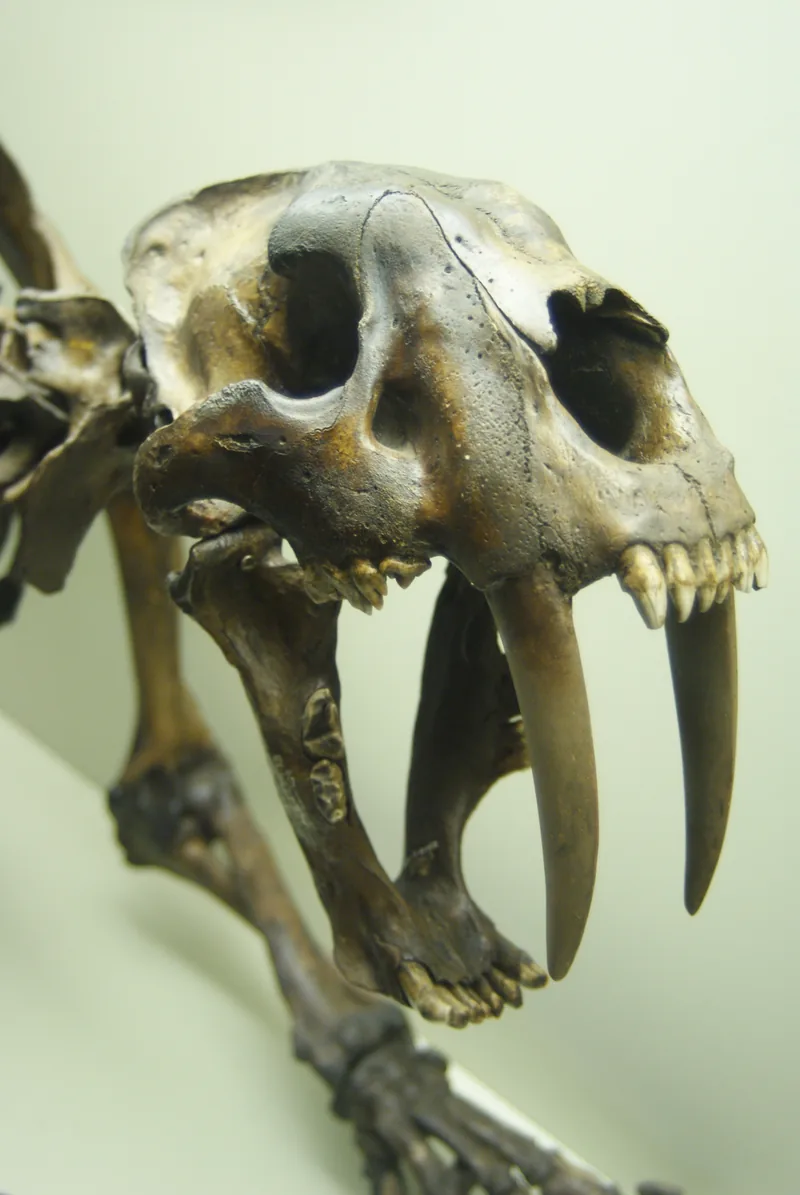
A Smilodon skull at the Page Museum at the La Brea Tar Pits, photographed by Dallas Krentzel on 25 February 2012. The file does not name a species, and this site does not invent one. Licensed CC BY 2.0. Photo: Dallas Krentzel, 25 February 2012 · CC BY 2.0 · Wikimedia Commons A name from 1842
The first Smilodon fossils were discovered in the 1830s in Brazil and named S. populator by Peter Wilhem Lund in 1842.[source]
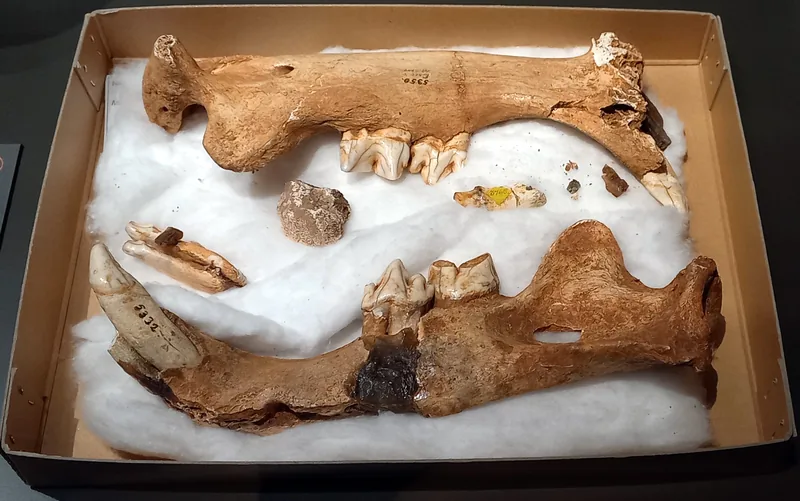
A Smilodon populator mandible collected by Peter W. Lund in Brazil in 1845, at the Natural History Museum of Denmark, Copenhagen, photographed by FunkMonk on 14 October 2024. Official National Park Service wording says the species was named by Peter Wilhem Lund in 1842; the 1845 collection date stays with this file. Licensed CC BY-SA 4.0; used on the website only. Photo: FunkMonk, 14 October 2024 · CC BY-SA 4.0 · Wikimedia Commons A Texas cave, and Joseph Leidy
The first S. fatalis fossils from North America came from a cave in Texas, and were named by Joseph Leidy in 1869.[source]
The California state fossil
Thousands of S. fatalis fossils have been collected from Rancho La Brea, “and thus is the California state fossil.”[source]
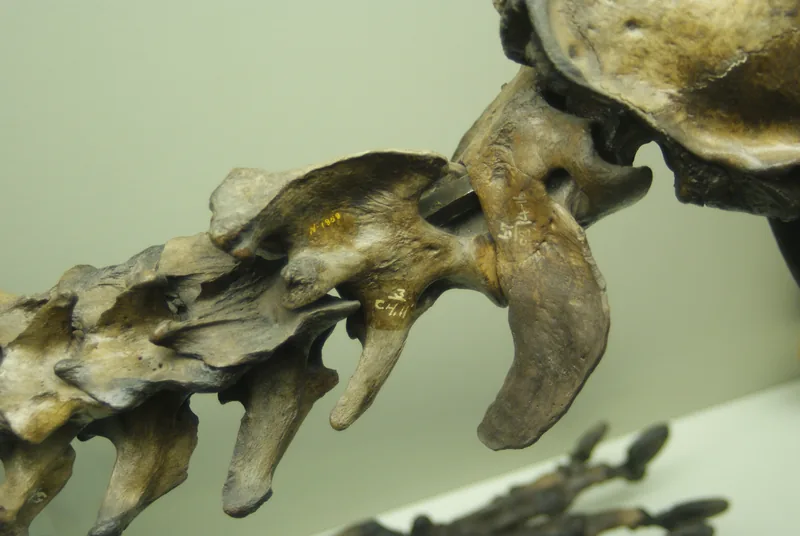
A Smilodon mount at the Page Museum at the La Brea Tar Pits, photographed by Dallas Krentzel on 25 February 2012. The file names it Smilodon, without a species. Official wording says thousands of Smilodon fatalis fossils have been collected from Rancho La Brea, and that it is the California state fossil; that official wording is not used here as a species label for this particular mount. Licensed CC BY 2.0. Photo: Dallas Krentzel, 25 February 2012 · CC BY 2.0 · Wikimedia Commons The oldest, and the slightest
S. gracilis lived 2.5 million years ago and was smaller and less robust than the later species.[source]
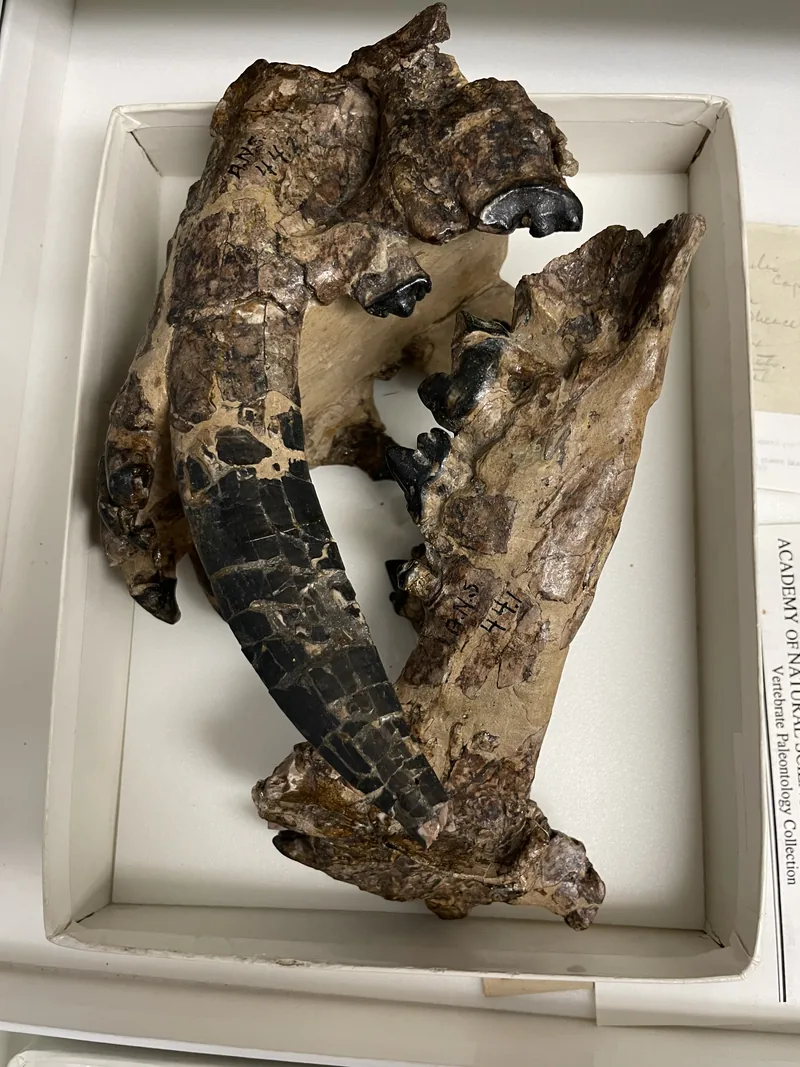
A partial Smilodon gracilis skull, specimen ANSP 44.1, unearthed from Port Kennedy Cave and deposited at the Academy of Natural Sciences of Philadelphia, photographed by Augustios Paleo on 27 February 2023. Official wording calls S. gracilis the oldest species, which lived 2.5 million years ago and was smaller and less robust. Licensed CC BY-SA 4.0; used on the website only. Photo: Augustios Paleo, 27 February 2023 · CC BY-SA 4.0 · Wikimedia Commons As far north as Alberta
Fossils of S. fatalis have been found as far north as Alberta, and as far south as parts of northwestern South America.[source]
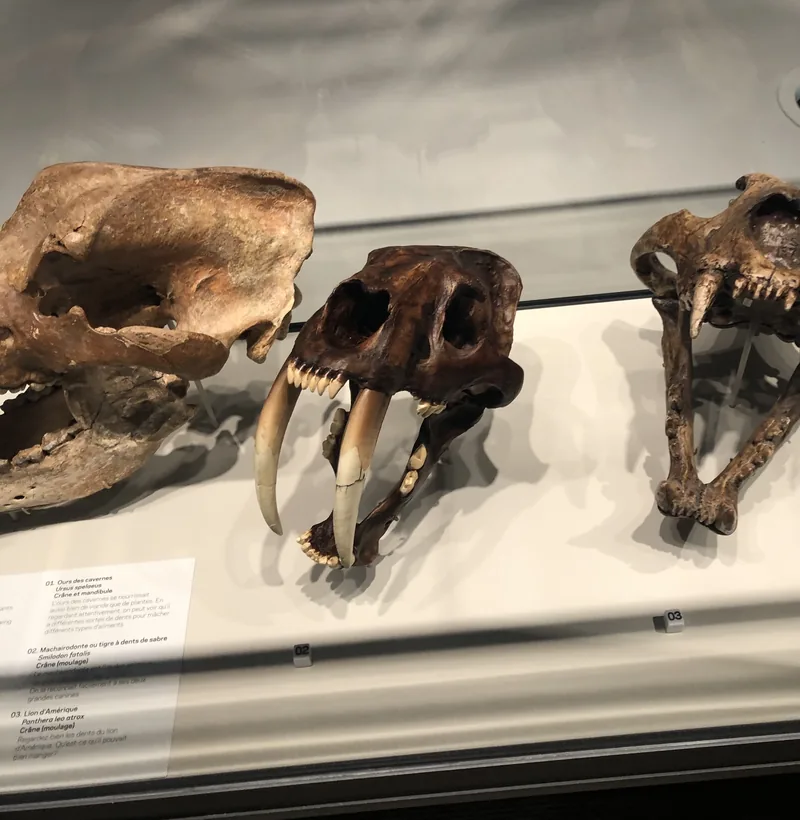
Smilodon fatalis at the Royal Alberta Museum, photographed by Qwexcxewq on 17 December 2022. Official National Park Service wording says fossils of S. fatalis have been found as far north as Alberta, Canada. Licensed CC BY 4.0. Photo: Qwexcxewq, 17 December 2022 · CC BY 4.0 · Wikimedia Commons A shortened tail, like a bobcat
Official wording gives robust forearms for grasping prey, and “a shortened tail, much like the living bobcat.”[source]
Healed injuries, a careful suggestion
Several fossils exhibit healed injuries, which have led some palaeontologists, in official wording, to suggest a social structure that shared resources. That is a suggestion, not a settled fact.[source]
Three years to grow a canine
Saber-like canines started to develop around 12 to 19 months, and were fully formed by 3 years — a longer growth period than in modern big cats.[source]
Two official endings
NPS: both species “went extinct roughly 10,000 years ago.” NHM: Smilodon lived “between 2.5 million and 12,000 years ago.”[source][source]
The second-largest cat at Tule Springs
S. fatalis was “the second largest extinct cat at Tule Springs.” The largest, on the same official page, was the American lion, Panthera atrox.[source]
A first for southern Nevada
Tule Springs was “the first record of Smilodon in southern Nevada.” The first described fossils were collected in 2003 and described in 2016.[source]
A sabre-tooth idea, much earlier
Diegoaelurus vanvalkenburghae lived “over 40 million years before the sabre-tooth tiger,” official NHM wording says, and is among the earliest sabre-toothed mammals. Machaeroidines looked similar to cats but were not closely related to them.[source]
A form that evolved more than once
Official wording: the sabre-tooth form evolved multiple times, including in Thylacosmilus, the nimravids, and cat relatives such as Smilodon.[source]
Enjoyed this sabre-tooth desk?
No pop-ups. No intrusive advertising. Just interesting stuff. A little support helps the next fossils.im site get built.